Dog Enrichment & Lessons from EYFS Activities
Dog Enrichment & Lessons from EYFS Activities
Ever get home after a long, mentally taxing day at work and just feel… spent? You’ve been solving problems, navigating tricky conversations, maybe even learning a new bit of software. Your brain is fried. Now, cast an eye over to your dog, who is likely vibrating with excitement to see you. What has their day looked like? For many of our dogs, it’s a lot of waiting around. That thought is what started me down a fascinating rabbit hole, leading to a surprisingly effective framework for brilliant dog enrichment: the guidelines used for teaching human toddlers, known as the Early Years Foundation Stage (EYFS).

I know, it sounds a bit strange at first glance. A curriculum for under-fives applied to our canine companions? But when you dig into it, the parallels are undeniable. The principles that help young children grow into curious, confident, and well-adjusted little people are remarkably similar to what our dogs need to lead fulfilling lives. At its heart, enrichment isn’t just about a long walk or a game of fetch. It’s about nurturing your dog’s incredible mind, honouring their natural instincts, and giving them a genuine sense of purpose beyond just waiting for you to come home.
What is the EYFS and Why Should Dog Owners Care?
So, what exactly is this EYFS thing? In the UK, the Early Years Foundation Stage is the official framework that all schools and nurseries use for children from birth to age five. It’s not about rote memorisation or forcing kids to learn their ABCs. Instead, it’s a philosophy built on the beautiful idea that children learn best when they are actively involved in their own discovery. Think learning through play, getting hands-on with sensory experiences, and being encouraged to think for themselves.
The moment this clicked for me as a dog daycare owner was huge. Our dogs, in all their glorious, muddy, tail-wagging brilliance, are basically perpetual toddlers. They’re curious, they live in the moment, and they thrive when they’re engaged and figuring things out. A standard walk around the block on a short lead is perfectly fine, but in EYFS terms, it's the equivalent of telling a toddler to sit still in a chair and not touch anything. True satisfaction and learning, for both kids and canines, comes from interaction, exploration, and the freedom to investigate the world on their own terms. Adopting an EYFS mindset can genuinely transform your dog’s well-being.
Translating EYFS Activities into Dog-Friendly Fun
You don't need a whiteboard or a formal lesson plan, I promise. This is all about weaving small, purposeful moments of play into your dog's day. The amazing thing is that this kind of mental stimulation can tire a dog out just as effectively, if not more so, than a long, strenuous run. A tired dog is often a happy, calm dog.
From 'Concept Development Activities' to Canine Problem-Solving
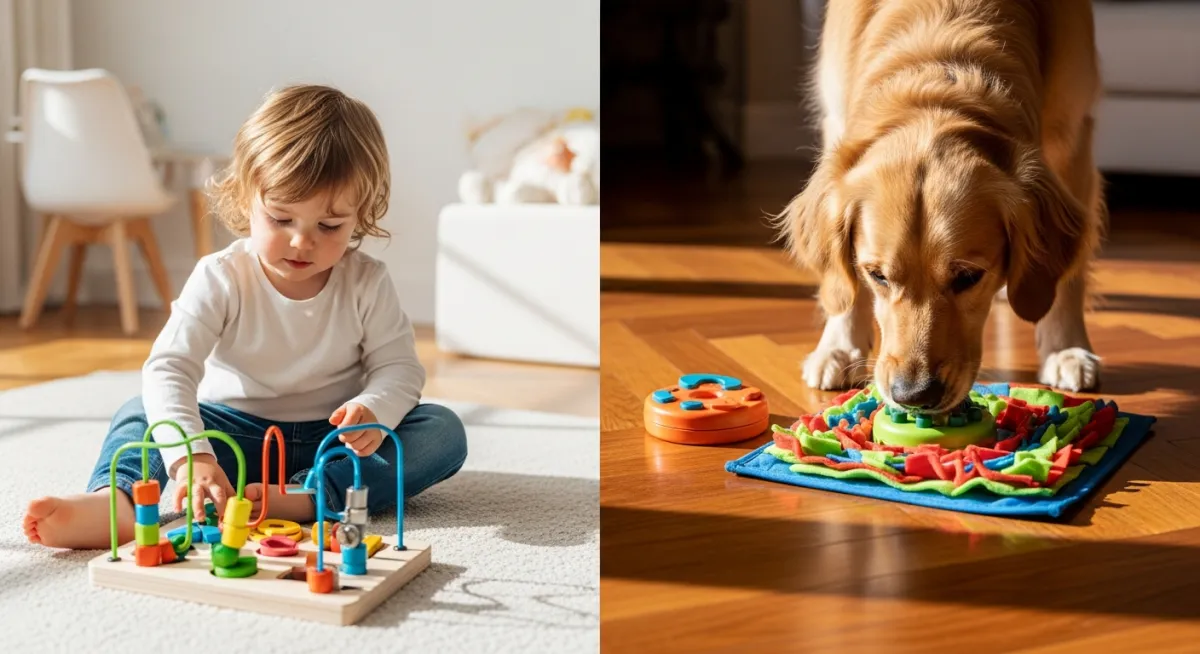
Walk into any nursery and you'll see children deeply engrossed in what educators call concept development activities. These are things like shape-sorters, simple puzzles, or building blocks that teach cause and effect. Each successful attempt builds new neural pathways and boosts their confidence. We can, and absolutely should, replicate this for our dogs to nurture their inner problem-solver.
Puzzle Feeders:This is the single easiest way to start. Instead of just plopping their food in a bowl (which is gone in 17 seconds, right?), use a puzzle feeder. These toys require your dog to nudge, paw, roll, or slide different parts to release their kibble. It turns a routine meal into an engaging brain game that satisfies their instinct to work for their food.
Snuffle Mats:These are essentially fabric mats with lots of fleece strips and folds where you can hide treats or kibble. This simple tool is incredible because it encourages your dog to use their most powerful tool: their nose. Sniffing is a calming, deeply rewarding natural behaviour that we often rush them through on walks.
The 'Find It' Game:A timeless classic for a reason. Start simple. Let your dog see you hide a high-value treat under a cushion and say 'Find it!'. Celebrate wildly when they do. As they get the hang of it, you can make the hiding spots more complex, using different rooms or even a few cardboard boxes to create a treasure hunt.
Sensory Play: More Than Just a Sniff
Sensory play is a massive part of early years education. Think sandpits, water tables, play-doh, and different textures. It’s all about helping children explore and understand the world through all their senses. For our dogs, their world is primarily experienced through scent, but that doesn't mean we can't engage their other senses too.
Instead of a brisk, military-style walk, try going on a 'sniffari'. This is a walk where your dog is completely in charge. Let them decide the pace and the direction. If they want to spend a full five minutes investigating one blade of grass, let them. They aren't just sniffing; they are reading the local news, figuring out which other dogs have been by, what they had for breakfast, and how they were feeling. It's incredibly stimulating for them and a wonderful way to de-stress.
Using 'Intervention Activities' for Building Skills
In a school setting, if a child is struggling with a particular skill, a teacher might introduce targeted intervention activities to offer extra support in a fun way. We can borrow this fantastic concept for our dogs. For example, if you have a shy or nervous dog, you can create tiny confidence-building exercises. Maybe it's learning to put two paws up on a stable box, or walking across a strange-feeling surface like a plastic sheet laid on the floor. For an excitable dog who struggles to settle, an 'intervention activity' could be practising a 'settle' command on a mat, but turning it into a game where they get rewarded for calmness in different rooms of the house. It's all about spotting a need and inventing a positive, game-based solution.
Creating Your Own Dog Enrichment Policy
Thinking about a personal enrichment policy might sound a bit formal, but it’s really just a promise to yourself and your dog. It's about consciously committing to meeting their mental and emotional needs, not just ticking the boxes of food, water, and shelter. This focus on their happiness has a wonderful side effect, too. It provides incredible user enrichment for you, the owner. The bond you build by playing, training, and simply observing your dog as they figure things out is one of the greatest joys of having them in your life.
Your personal policy could rest on a few simple pillars:
Variety: You wouldn’t give a toddler the same single toy to play with day after day. Do the same for your dog! Keep a box of toys and rotate them every week. The return of a toy they haven't seen for a few days can feel like getting something brand new.
Balance: A healthy life is all about balance. Make sure your dog’s day has a good mix of different things: energetic physical exercise like a run, focused mental challenges like a puzzle toy, and calming activities like methodically chewing on a natural treat or enjoying a good sniff in the garden.
Choice: This one is so simple but so powerful. Giving your dog small, simple choices throughout the day can massively reduce their stress levels because it gives them a sense of control over their world. Let them choose which toy to play with, or which turning to take on a walk.
Safety:This is paramount. Always supervise your dog with any new toy or activity. Check toys regularly for signs of wear and tear, and remove anything that could become a choking hazard. Enrichment should be fun, not dangerous.
By looking at your dog's world through this lens, you stop being just a carer and become a facilitator of joy, learning, and discovery. The best dog enrichment isn't about buying the most expensive gadgets; it’s about thoughtful, purposeful engagement that truly honours the clever, funny, and amazing animal you share your life with.
Just thinking about how you can build a few more of these moments into your dog's day is the perfect place to start. For more ideas or to see how we build enrichment into everything we do, feel free to explore our approach at the Dog Adventure Centre or get in touch through our contact page.
Frequently Asked Questions About Dog Enrichment
How much enrichment does my dog need every day?
There's no magic number, as it really depends on your dog's age, breed, and personality. However, a great starting point is to aim for 15-20 minutes of dedicated, focused brain work each day. This could be one puzzle-feeding session, a short training game, or a 'sniffari' around the garden. It's more about the quality of the engagement than the sheer quantity of time spent.
My dog just destroys puzzle toys. What can I do?
This is a common issue! It often comes from frustration or not understanding the game. First, always supervise them. Second, start with a very easy puzzle to build their confidence. You can also look for toys made from more durable materials. If they start chewing the toy itself, calmly redirect them to an appropriate chew item. The goal is to teach them to solve, not to destroy.
Are there any free or low-cost enrichment ideas?
Absolutely! Enrichment doesn't have to be expensive. You can create fantastic brain games with things you already have at home. Hide treats in an old towel and roll it up. Get a cardboard box, fill it with scrunched-up paper, and scatter their kibble inside. Playing hide-and-seek with your dog around the house is also a brilliant, free way to engage their mind and body.
Can you do too much enrichment?
Yes, it is possible. Just like humans, dogs can get overstimulated and overwhelmed. It's important to balance these fun activities with plenty of downtime and rest. A dog needs to learn how to be calm and settled, too. If your dog seems frantic, stressed, or unable to switch off, it might be a sign to scale back the intensity and focus more on calming activities like sniffing and chewing.

Testimonials
Quite simply for the work I do I wouldn’t be able to have a dog without “Who lets your dog out”…the fact that my dog loves the days she spends with Sara and her team meeting other dogs is a massive bonus…..my puppy literally runs out to meet them when they arrive!
I consider myself lucky to have found such flexible and reliable care for my VIP puppy
Thanks WLYDO
Ashley Johnson & Doris
Outstanding service, totally reliable and Sara and her team have been brilliant with our dog Lola over the past year who loves seeing them and I am extremely grateful and happy with their service.
Dr Alun Yewlett & Lola
Sara and the team have had our rescue puppy for almost a year, and they have been amazing. Caddie was very nervous around people when we first got her but the team understood that and have been fantastic with her! Could not recommend these guys anymore!
Nathan Gray & Caddie

Who Lets Your Dog Out? Ltd © 2026
VAT Registration No: 454 626 775
Licensed by SKDC license number: A33029


